Why iMessage Gets Higher Response Rates Than SMS
iMessage gets 2-3x higher response rates than SMS or email. Here's the data behind it and how sales teams are using it directly from their CRM.
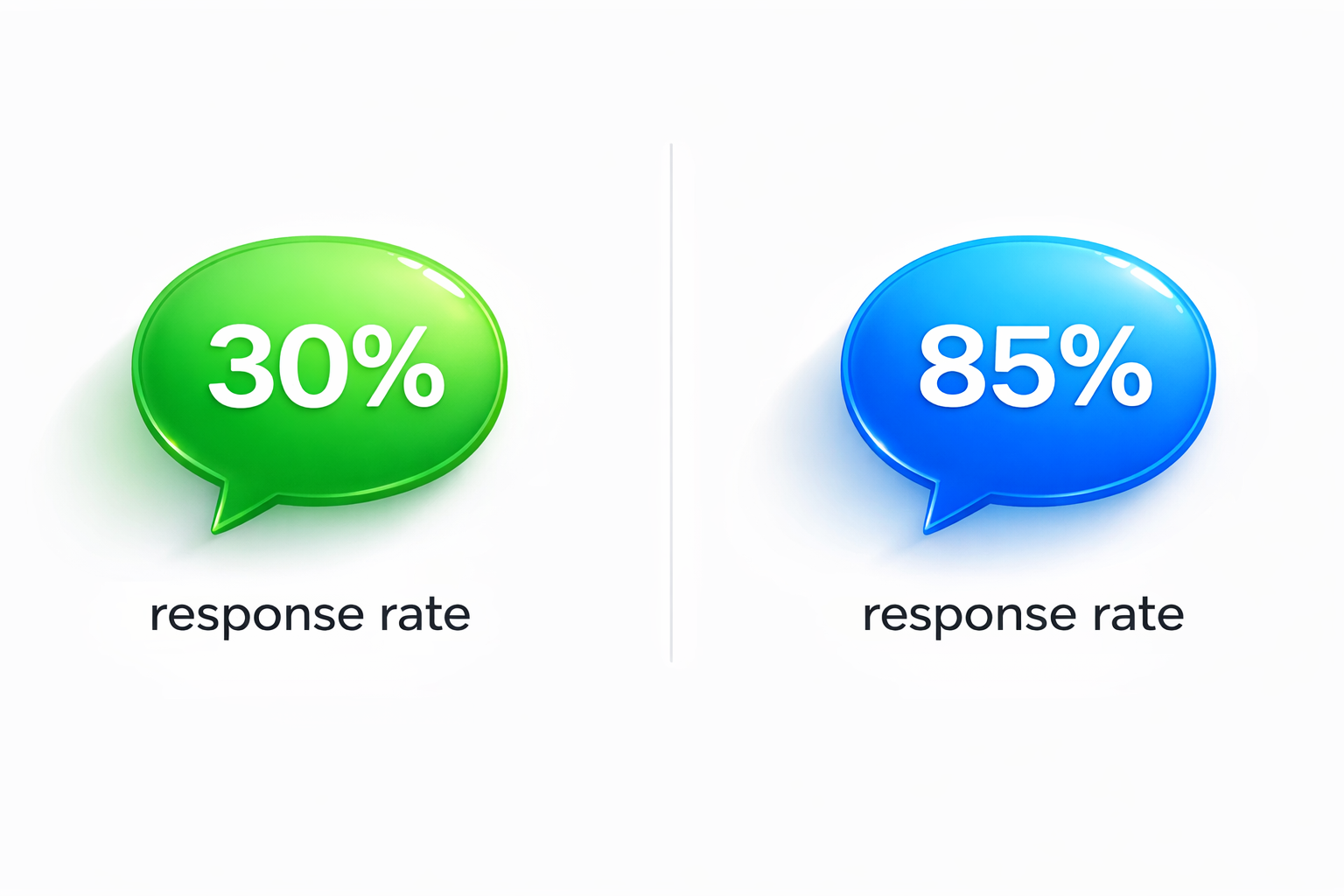
If your business relies on texting customers - whether for sales outreach, appointment confirmations, or lead follow-ups - you've probably noticed a frustrating pattern. You send hundreds of messages. You know people are receiving them. Yet your response rate stalls around 25-30%.
Most businesses assume the problem is their copy. They rewrite the message. They test different offers. They change the call-to-action. But after analyzing over 10,000 follow-up messages across hundreds of businesses, a surprising pattern emerged: the color of the message bubble matters more than the words inside it.
The delivery channel - SMS vs iMessage - has a massive impact on whether people reply. And businesses that send iMessages from their CRM are seeing dramatically better results.
The Numbers Don't Lie
When we compared identical follow-up messages sent through different channels, the results were clear:
- SMS (green bubbles): ~30% response rate
- iMessage (blue bubbles): 80-90% response rate
These were the same businesses, sending similar messages, to similar audiences. The only difference was how the message appeared on the recipient's phone. Green bubble vs blue bubble. And that visual difference dramatically changed how people reacted.
The Psychology Behind Blue vs Green Bubbles
Most people receive dozens of automated texts per week - delivery notifications, appointment reminders, banking alerts, verification codes, promotional offers. Nearly all of these arrive as SMS messages, which show up as green bubbles on an iPhone.
Over time, your brain starts recognizing patterns. Without realizing it, people learn this mental shortcut: green bubble = automated message = not urgent. People glance at the notification, assume it's automated, and move on.
Now compare that with a blue bubble. For most iPhone users, iMessage is where real conversations happen - friends, family, coworkers, clients. The brain interprets blue bubbles differently: blue bubble = person = conversation. This small visual cue dramatically changes how people respond.
Why Traditional SMS Follow-Ups Fail
Most businesses unintentionally make their SMS messages look like marketing blasts. A typical follow-up message has three major problems:
1. The Paragraph Problem
Long blocks of text instantly feel automated. People associate them with mass messaging software, not real people. Even if the message is genuine, the format creates distrust.
2. It Feels Like Marketing
Phrases like "comprehensive solutions," "discuss your goals," and "schedule a time" sound like sales copy. Sales copy triggers resistance. People didn't open their messages hoping to read a mini sales letter.
3. There's No Proof You're Human
SMS offers very limited ways to show you're a real person. To the recipient, text-only messages look exactly like spam, promotions, and automated alerts. There's nothing that signals a real human is typing.
How iMessage Changes the Game
When you switch to iMessage, the entire communication experience changes.
Instant Trust Signals: Blue bubbles create an immediate sense of familiarity. Recipients assume the message is coming from an individual, not a marketing system.
Rich Communication Features: iMessage supports voice messages (proving a real human is reaching out), read receipts, high-quality media, and reactions - all features that make business messaging feel like a normal conversation.
Natural Conversational Flow: Instead of one long paragraph, you can message the way people actually text. A quick intro, a pause, then maybe a voice note. This feels like a person reaching out, not a campaign being blasted.
What the Data Shows Actually Works
After analyzing more than 10,000 real follow-up conversations, several clear patterns emerged.
Short Messages Win
Response rates drop as messages get longer. Under 10 words achieved an 83% response rate, while 10-25 words achieved 71%. The purpose of the first message isn't to sell - it's to start a conversation.
Voice Messages Increase Trust
Text-only messages achieved ~68% response rate, while text + voice message achieved ~91%. Voice notes work because they instantly prove a real person is on the other end. The key is keeping them short - under 20 seconds.
Timing Matters Less Than You Think
When tested at different times (8 AM, noon, 3 PM, 6 PM, 9 PM), there was only about 7% variation in response rates. Channel and message format matter far more than timing.
The ROI of Switching to iMessage
Consider a business generating 200 leads per month:
- With SMS: 30% response rate → 60 conversations → 12 clients → $36,000/month
- With iMessage: 85% response rate → 170 conversations → 34 clients → $102,000/month
That's an increase of $66,000 per month, or $792,000 per year, without generating a single additional lead. The only change was how the messages were delivered.
Why Most Businesses Haven't Noticed This Yet
SMS platforms have been around longer and are easier to integrate. Many businesses assume text is text, regardless of how it appears. But customers don't experience it that way. The difference between green and blue bubbles is the difference between marketing noise and a real conversation.
The Bottom Line
If your business uses text messaging to follow up with leads, the delivery channel matters far more than most people realize. Businesses relying on SMS see response rates around 25-30%. Those using iMessage with conversational messaging see 80-90%.
The difference isn't better copywriting. It isn't perfect timing. It's simply changing the environment where the conversation happens.
The businesses getting 80-90% response rates are doing something simpler - they're making their outreach feel like a conversation instead of a campaign. Ready to make the switch? Send iMessages directly from your CRM with Sendara.
Frequently Asked Questions
What response rate does iMessage get compared to SMS?
iMessage achieves 80-90% response rates compared to SMS which typically sees 25-30%. This is based on analysis of over 10,000 follow-up messages across hundreds of businesses.
Why do blue bubbles get more replies than green bubbles?
Green bubbles (SMS) are subconsciously associated with automated marketing messages, while blue bubbles (iMessage) signal a personal conversation from a real contact. This psychological difference dramatically impacts engagement.
Can I send iMessages from my CRM?
Yes. Platforms like Sendara integrate directly with CRMs like GoHighLevel, HubSpot, Close, Salesforce, and Pipedrive, allowing you to send iMessages from your existing workflows.
What is the ROI of switching from SMS to iMessage?
A business generating 200 leads/month can see revenue increase from $36,000 to $102,000 per month simply by switching from SMS to iMessage - without generating a single additional lead.
Ready to Switch to iMessage?
Start sending iMessages from your CRM today. No A2P registration. No carrier delays.
Book a Demo